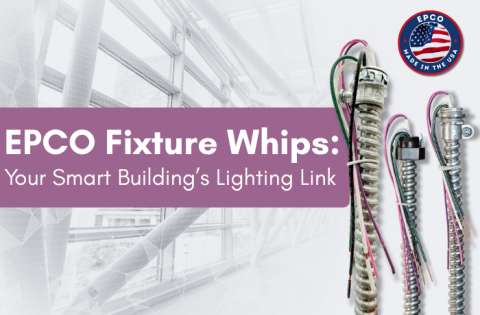
When it comes to modern lighting installations, precision and efficiency are key. EPCO offers a range of illumination control fixture whips designed to streamline the wiring process and ensure reliable performance. Among our popular offerings are the ½" conduit whips, ⅜" conduit whips, and five-wire whips. Let's break down the differences to help you choose the right solution for your next project.
The Core Function: What is a Fixture Whip?
Before diving into the specifics, it's helpful to understand the purpose of a fixture whip. Fixture Whips are a pre-assembled, flexible wiring assembly used to connect a lighting fixture to a building's electrical system, typically in suspended ceilings.
This pre-fab approach significantly reduces installation time and labor costs by eliminating the need to cut, strip, and terminate individual wires or MC cable on-site. For illumination control, these whips are specifically designed to carry both power and control signals to lighting fixtures.
1. EPCO ½" Conduit Illumination Control Fixture Whips
Description: These 600V rated whips feature ½" flexible metal conduit (FMC) that protects the electrical conductors, providing ample space for up to four conductor wires and two control wires in tray cable.
Key Features & Advantages:
- Robust Protection: The ½" conduit provides excellent physical protection for the enclosed wires against damage, moisture, and EMI (electromagnetic interference).
- Capacity: The larger conduit size allows for more or larger gauge conductors.
- Code Compliance: By incorporating control wires within tray cables, this design complies with National Electrical Code standards for combining power and lighting circuits with Class 2 or Class 3 control circuits within the same fixture whip.
2. EPCO ⅜" Conduit Illumination Control Fixture Whips
Description: Similar to ½" whips, this 300V configuration utilizes ⅜" flexible metal conduit (FMC) to house the electrical wires.
Key Features Advantages:
- Cost-Effective: Generally, ⅜" whips can be more cost-effective due to less material usage compared to ½" whips.
- Sufficient Protection: While smaller, the tray cable and conduit still provide good protection for the conductors against minor damage and EMI.
- Code Compliance: By incorporating control wires within tray cables, this design complies with National Electrical Code standards for combining power and lighting circuits with Class 2 or Class 3 control circuits within the same fixture whip.
3. EPCO Five-Wire Illumination Control Fixture Whips
Description: Unlike the ⅜" and ½" Illumination Control Whips, these whips are built with control wires not in tray cable. The conduit size is ⅜".
Key Features Advantages:
- Cost-Effective: Generally, the combination of basic conductors with ⅜" conduit is more cost-effective due to less material usage compared to our other offerings.
Key Considerations (Potential Disadvantages):
- Code Restrictions: Certain electrical codes or applications may require wiring to be enclosed in conduit, limiting the use of this style of whip. Per NEC, this whip is classified as Class 1 and does not meet code requirements for Class 2 and Class 3.
By carefully considering these aspects, you can select the optimal EPCO fixture whip that ensures a safe, efficient, and reliable lighting control system. Always consult product specifications and local electrical codes to guarantee compliance and optimal performance.